I'm just a human who wants to share my knowledge with the hope that I can help at least one person with what I know. I was - still do, search on internet before wanting to do anything and it would help a lot to have some sort of insight before starting it so here you go people
STPM Semester 1 Biology Experiment 2 : Preparation and observation of slides of animal and plant cells
Get link
Facebook
X
Pinterest
Email
Other Apps
Hey Moons! There are the answers and the manual. Hope you can benefits from this and cheers!
Animal and plant cells are fundamental units of life with key differences. Animal cells lack a cell wall and chloroplasts, but possess centrioles. Plant cells have cell walls, chloroplasts for photosynthesis, and large central vacuoles. Both contain organelles like the nucleus, mitochondria, endoplasmic reticulum, Golgi apparatus, and lysosomes. These organelles perform specific functions vital for cell survival. Animal cells are typically round and irregularly shaped, while plant cells have a more defined rectangular shape due to the cell wall. Both types of cells are essential building blocks for complex organisms.
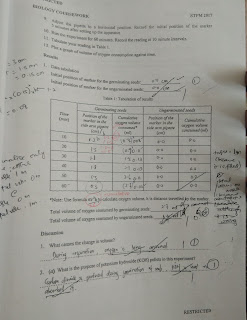
These are the answers and part of the manual. Unfortunately I deleted the first page so I only have the rest. Sorry for that. If I found it, I would include it as well.



Thankyou it is very helpful
ReplyDeleteBiology stpm sem 1 experiment 3 answers plss
ReplyDeleteMy teacher said answer in part B 1st questions is protoxylem, epidermis and parenchyma.
ReplyDeleteThank you so much
ReplyDeleteAnimal and plant cells are fundamental units of life with key differences. Animal cells lack a cell wall and chloroplasts, but possess centrioles. Plant cells have cell walls, chloroplasts for photosynthesis, and large central vacuoles. Both contain organelles like the nucleus, mitochondria, endoplasmic reticulum, Golgi apparatus, and lysosomes. These organelles perform specific functions vital for cell survival. Animal cells are typically round and irregularly shaped, while plant cells have a more defined rectangular shape due to the cell wall. Both types of cells are essential building blocks for complex organisms.
ReplyDeletewhy they are all divided by 0.01?
ReplyDelete